
Yellowknife’s Real Estate Market: 2025 Year-End Update
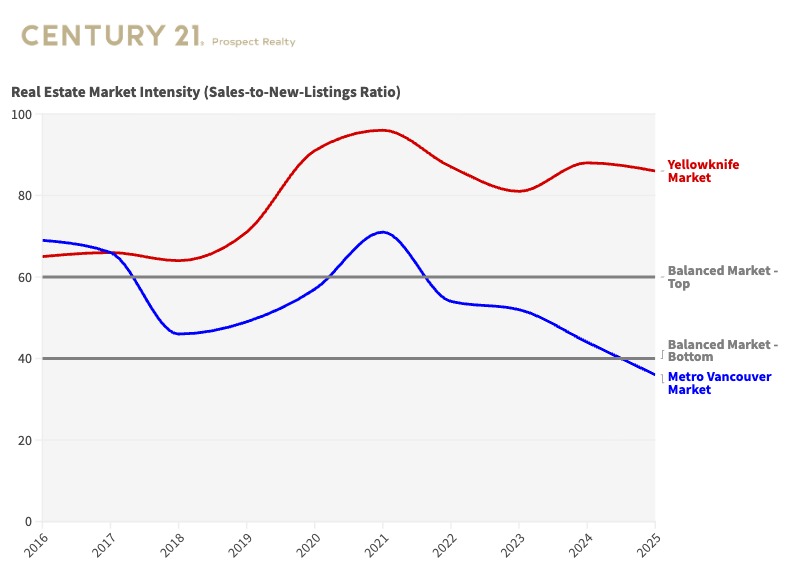
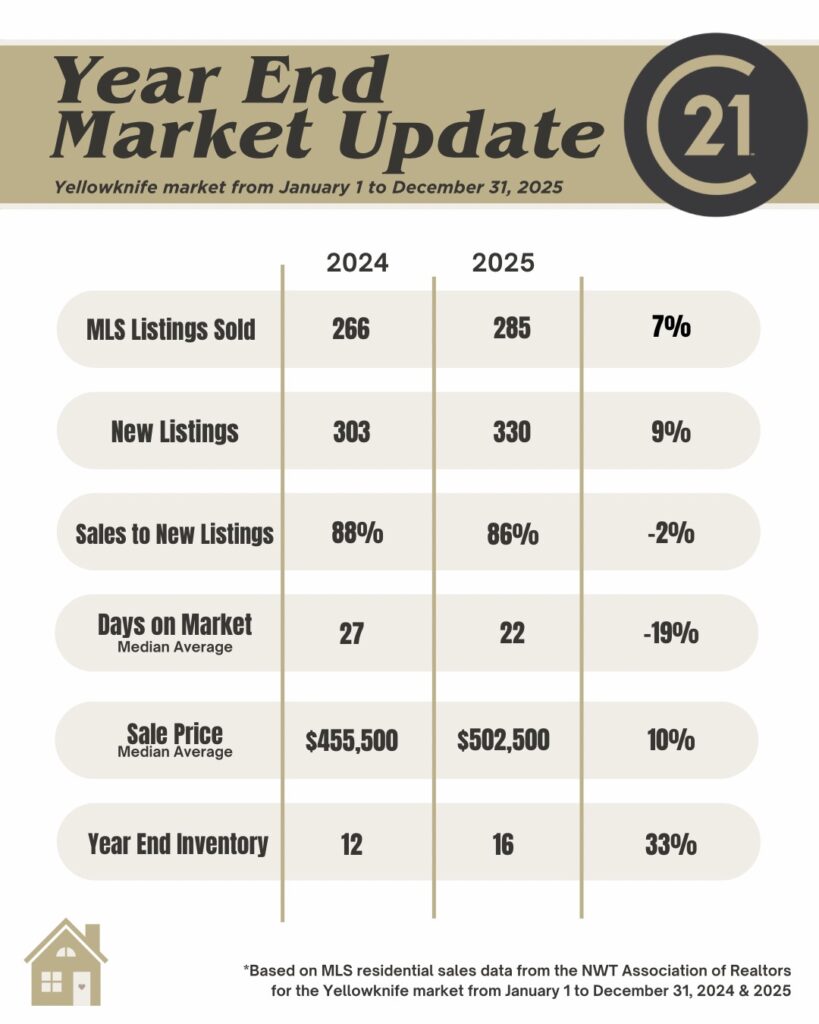 Well, another year is in the books for the Yellowknife real estate market and for about the 8th year in a row the two most important factors have been our continued population growth and our lack of supply of new housing. More and more Yellowknifers find themselves competing for an inventory of homes that isn’t really growing. Buyers and, more importantly, developers, simply do not have the option here of building new homes because there is no land available through the City of Yellowknife. Yes, infill development (the redevelopment of old properties) presents an opportunity for the development of some housing formats like low-rise multi-family housing, but it’s not an option for detached homes, which continue to be the preferred type of housing. As a result, prices keep rising at a pace that exceeds the national average. Our median average home price was up 10% over 2024, whereas the Canadian Real Estate Association’s Home Price Index was down 4%.
When looking at the national picture, most reporting focuses on the two largest markets, Toronto and Vancouver, which both saw declines. Because they are so big, they skew the national averages downward. I can’t tell you what the national picture looks like excluding those two markets because nobody seems to track that, but I do have detailed figures for the province of British Columbia, which give us an indication of what might be happening in smaller markets like ours. In 2025 Vancouver, Chilliwack and the Fraser Valley were down, but in the other 8 markets monitored by the BC Real Estate Association, average prices were up by 1.8% to 6.2%. The main reason these smaller markets are doing better is that unlike Toronto and Vancouver, they are not significant destinations for immigrants to Canada, so they were less impacted by recent cuts to immigration quotas.

Also of note, two other markets that bucked the national numbers to the high side were Quebec City and Regina. In both cases experts cite a lack of supply as a major contributing factor. You can read more about this here. And the main factor contributing to increased demand is the fact that housing is still seen as more affordable than in other markets.
And that brings us to an interesting observation. In BC, there are now only two markets with lower average home prices than Yellowknife – Northern BC ($443,971) and the South Peace River Region ($318,797). Our mean average sale price in 2025 was $538,022. Of course you can argue that because of our high percentage of modular homes and our high costs for other things like heat and power, this isn’t really an apples-to-apples comparison, but it’s not nothing. Especially if you consider our average household income levels, which continue to be amongst the highest in the country.
One other interesting point is that in the segments of our market where we see either increased supply or low demand, average price increases are much more modest. For example, there were a lot of new apartments added to the Yellowknife market over the last two years, which resulted in increased competition amongst condo sellers. The average condo price only increased by 1.8%, compared to 10% for all housing types.
The other area of softness was homes over $800,000. There aren’t enough of them to use average prices as a responsible measure of appreciation, but homes over $800k that hit the market in 2025 stayed on the market three times longer than homes under $800k – 75 days compared to 23 days. A full 28% of homes over $800k expired without selling, compared to only 8.5% below $800k.
Why is there softer demand for homes above $800,000? I don’t have any stats to back this up, but I suspect it’s because we don’t have a lot of jobs in Yellowknife with salaries that support the purchase of high-priced homes. We also have a transient population, so people don’t stay here long enough to build up the equity required to move up the ladder of homeownership without taking on bigger mortgages.
There are two other things that I should mention. Most years, we have a hard time predicting the market because we don’t know what interest rates are going to do. For the last two years, there was general consensus amongst economists that rates would be dropping, but this year, economists are split, with many calling for rates to stay roughly where they are today. This could of course change depending the side of the bed on which the narcissist-in-chief in Washington, DC, wakes up on any given day, but barring any major hits to our economy, rates should stay steady.
The other X-factor is the closure of Diavik Diamond Mine in two months time. I explained in a recent Facebook post (inserted below) why I don’t think Diavik is going to have much of an impact. Our market is simply too hot to be impacted by 30-40 additional listings. That said, should the recent federal loan to Ekati fail to ensure the mine owner’s survival through 2026, the picture might be different.